



The routine is over, the awards ceremony finally starts, and the emcee announces your dancer's group earned a High Gold. Everyone around you cheers. You clap too, while quietly wondering: is that good?
If you're confused by dance competition scoring, you're not alone. I've helped run a competitive dance studio for more than a decade, and I still have to explain this to new families every season. Here's how it works in plain English, for parents trying to follow along and dancers who want to score higher next time.
First, every competition speaks its own language
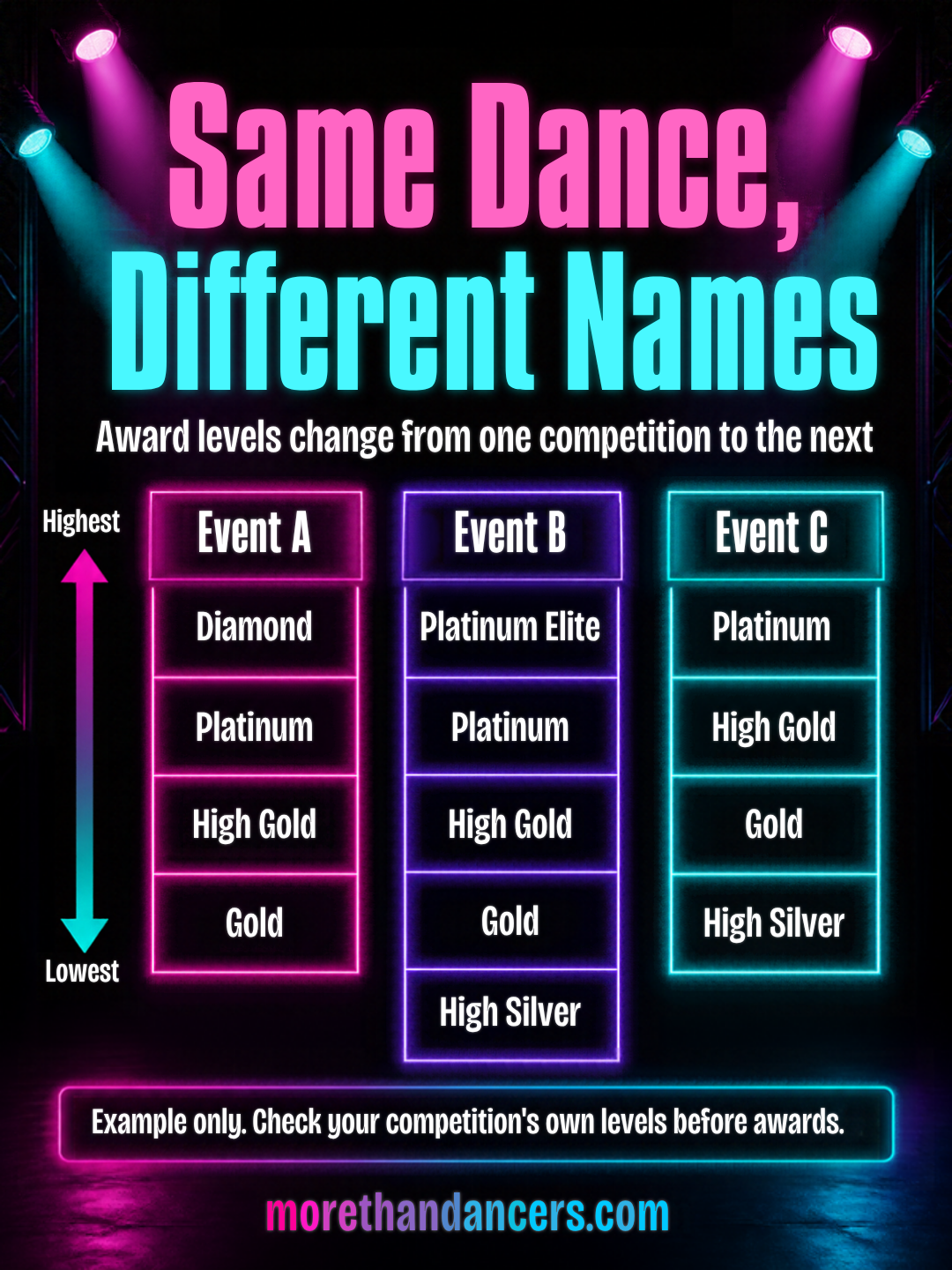
This is the biggest thing parents miss. There isn't one scoring system for dance competitions. Most competitions do it their own way. One event's top level is Diamond, another's is Platinum, and another uses names you've never heard. Gold at one event and High Gold at another might not mean the same thing at all.
So before the weekend, find out what that specific competition calls its levels and what order they go in. Your studio can usually tell you, or it's on the competition's website. It saves a lot of confusion at awards.
The two kinds of awards
Most competitions give out two different kinds of results, and mixing them up causes most of the confusion.
Adjudication awards are about your score, not anyone else's. Every routine gets scored on its own, and the score lands it in an award level like Platinum or High Gold. Many routines in the same category can earn the same level. You're competing against a standard, not against each other.
Overalls are rankings. After adjudication, the top-scoring routines in a category are ranked first, second, third and so on. Dance Parent 101 explains that overalls are usually split by age division and group size, and sometimes by style. This is where dancers are compared directly.
So it's completely possible to earn a Platinum and not place in the overalls, if a lot of strong routines were in the same category. That's not a bad day. That's a strong routine in a strong field.
How judges score a routine
At many competitions, a panel of three judges scores each routine. Dance Parent 101 describes the common setup: each judge scores out of 100, and the three scores are added for a total out of 300. That total decides the award level.
What are judges looking at? Each competition sets its own score sheet, but most cover the same areas. DX Events, for example, publishes its breakdown:
- Technique: 35 points. Placement, control, body awareness, and how well skills are executed.
- Choreography and execution: 35 points. Musicality, use of space, formations, transitions, difficulty and originality.
- Showmanship: 20 points. Energy, expression and emotional connection with the audience.
- Costume: 10 points. Whether it's age-appropriate and stays in place.
Other events weigh things differently or use categories like "overall impression," but the big three are almost always technique, performance and choreography.
Every style is judged a little differently
Here's something you won't see on most score sheets. Even when the big headings are the same, each style really has its own rubric. An acro routine, a jazz routine and a ballet routine might all be scored on "technique," but what good technique looks like is different in each one.
That matters more than it used to. A while back there was a wave where routines turned into tricks on tricks on tricks. Dancers could execute the tricks, but the dancing got lost. You'd watch a routine and it was basically a song with a pile of tricks on top. That's why it helps to know each style is judged on its own terms. A jazz dance should still look like jazz. Some events also have an Open category, which is a melting pot for routines that mix a bit of everything.
What the award levels mean
The names change from event to event, but the ladder usually looks something like this, from highest to lowest:
- Diamond or Platinum Elite (the top level, at events that have one)
- Platinum
- High Gold
- Gold
- High Silver (at some events)
The score needed for each level depends on the event, and often on the dancer's level too. DX Events, for example, sets slightly different cutoffs for novice, intermediate and advanced dancers based on weekly training hours. For a novice routine there, Platinum starts at a score of 272 and High Gold at 262. For an advanced routine, the bar is a few points higher. Dance Parent 101 notes the same pattern elsewhere: some events use separate scales for newer dancers.
The takeaway: a High Gold at one competition isn't exactly the same as a High Gold at another. Compare your dancer to their own past scores, ideally at the same event, rather than to another studio's results at a different competition.
Special awards and titles
On top of scores and overalls, many competitions hand out special awards chosen by the judges. These might recognize things like choreography, entertainment value, costume, or a dancer's personality on stage. Some events also run title competitions for soloists, which usually involve an extra round or interview.
These awards are lovely when they happen and impossible to predict. Don't build the weekend around them.
Scores and critiques: what's yours to ask for
Most competitions give each routine a judge's critique, often a recording of the judge talking while they watch, or written notes. DX Events, for example, shares scores and verbal critiques with studio directors after the event.
A quick etiquette note. If your dancer has a solo, duet or trio, it's fine to ask your studio for that routine's score and critique after the competition. Group scores and critiques are different. Those usually stay with the coaches and studio owner, and asking to see them isn't great etiquette. It tends to create more problems than it solves, because suddenly parents start trying to coach the group. Let the teachers handle that part.
The best part: feed forward
Here's the secret experienced dancers know. The award is the least useful thing you get from a competition. The critique is the most useful. I like to call it feed forward instead of feedback, because the point isn't the dance you just did. It's the next one.
Be realistic about it, though. Sometimes a critique doesn't say much. That happens most in styles the judges aren't deeply trained in. Tap and hip hop are known for getting thinner critiques, because a judge who isn't a tapper or a hip hop dancer can miss the intricate stuff and ends up judging mostly on performance. If your tap dancer's critique feels light, that's probably why.
How to tell a judge's taste from something to work on. Look for patterns. If your dancer hears the same thing again and again, like point your feet or straighten your legs, that's not one judge's opinion. That's an invitation to work on it.
For dancers, here's how to use it:
- Listen to all of them, not just the nice parts. If two or three judges mention the same thing, that's your top thing to work on.
- Write down one technique note and one performance note. That's enough to focus on until the next competition.
- Bring them to class. Tell your teacher what the judges said and ask how to work on it.
- Do the personal work. Private lessons help, but no number of privates will fix something you're not aware of. Practice your dance on your own and think about the feed forward while you do.
- Record yourself and watch it back. Someone can tell you your leg isn't straight, and you'll swear it is. Even in the mirror it can look straight. Then you see it on video and go, oh wow, it's not. The camera doesn't argue.
For parents: let the critiques belong to your dancer and their teacher. Ask "What was your favorite thing a judge said?" instead of "What did they say you did wrong?" Your dancer will hear the corrections. They need to hear from you that you're proud of them.
When the score doesn't match the dance
Dance is subjective. The same routine, danced the same way, can score differently in front of a different panel. Sometimes the judges who were there that day just saw it a certain way.
Remember that judges don't know your dancer. They don't see them every week, and by the time your dancer takes the stage they may have judged more than 100 routines that day. Sometimes they're tired. Sometimes they miss something. Everyone has their own biases, and occasionally a judge has a relationship with some of the dancers competing. That's not common, but it does happen.
So what should your dancer anchor to? Their coach. If the coach says that was the best they've ever run that solo, believe it. That's the person who has watched every rehearsal and knows what your dancer is capable of.
So, is High Gold good?
Yes. So is Gold, especially early on. Award levels are a snapshot of one performance on one stage in front of three people. What matters more is the trend: cleaner technique, more confidence and higher scores over a season or two. That's the stuff that sticks.
And for the dancer who just earned their first Platinum? Celebrate it. They worked hard for that.
New to competitions? Read our guide to your first dance competition weekend, and sign up for the More Than Dancers newsletter for the free Competition Weekend Checklist.
Sources: Dance Parent 101, "Dance Competitions Explained"; DX Events judging page.
More from
For Parents
category


