




Your dancer's first competition is coming up, and you've got questions. What time do we need to be there? Where do they change? Do I stay the whole day? What on earth is a quick change?
Take a breath. Every dance parent has been the confused one in the hallway holding the wrong pair of tights. Me included. I've helped run a competitive dance studio for more than a decade, and I still remember my very first competition awards ceremony. It sounded like an auction. There were hundreds of entries, and the emcee just went number, award, number, award, number, award. I had no idea which number was ours, so I didn't know if I was supposed to cheer or not.
By the end of this guide you'll know what the weekend looks like, what to bring, and how to make it a good experience for your dancer, and for you.
The thing nobody tells you: it's an emotional weekend
Before we get to schedules and packing lists, here's what I wish every family knew going in. Competitions are emotional. Not just for the kids. Parents often feel more nervous, more excited and sometimes more disappointed than they expected, and most of us don't really know how to ride those ups and downs the first time.
Here's what helps me keep perspective. Your dancer has practiced for months for about two and a half minutes on stage. Walking out there, alone or with a team, under the lights, in front of judges and a full audience, takes real courage. Just showing up and dancing is a huge accomplishment.
And unlike most sports, nobody is out there trying to block them or outmuscle them. Dancers are really competing against themselves. They get scored on how well they perform their own routine, and the cleaner they execute it, the better the "grade."
I tell parents all the time: get on stage yourself at least once. A parent dance, a Nutcracker cameo, whatever your studio offers. Once you feel those nerves in your own body, you'll never look at your dancer's two and a half minutes the same way again.
What the weekend actually looks like
Most regional competitions run one to four days. Dance Parent 101 notes they often start on a Friday afternoon or early Saturday and can run until around 10 at night. Some longer events run midweek through Sunday.
Routines are grouped by age, style and group size, and the schedule usually comes out a week or two ahead. Your studio will tell you when each routine is on stage. Here's the part nobody warns you about: the schedule is a best guess. Competitions often run ahead or behind, so most studios ask dancers to be ready well before their stage time. Plan on arriving at least an hour and a half to two hours early, or whatever your studio asks.
Awards usually happen in blocks after a set of routines, which can mean waiting around between dancing and finding out results. Some events run late into the night. If there's a convention attached, like the ones CLI Studios describes, dancers may take classes all day and compete in the evening.
Know your routine numbers. Every routine gets an entry number, and that's how results are announced. Write your dancer's numbers down or save them in your phone before awards start, so you know exactly when to cheer.
The coach leads. You support.
This is the one that makes a weekend smooth or stressful, so I'll say it plainly. The coach is the leader. Your job as a parent is to support both the coach and your kid. You don't need to lead too.
That means you don't need to manage where your dancer is every minute or try to control their energy. Their energy is going to be what it is. Stay calm, follow the studio's instructions, and let the teachers handle warm-ups, notes and corrections. A calm parent makes a calm dancer.
Your jobs, roughly in order:
- Getting them there early, fed and with hair and makeup done or nearly done, depending on what the studio asks.
- Helping with changes. Dressing rooms are often shared, busy and short on space. Some studios have a team mom or backstage helpers who handle this.
- Finding your seat to watch. Most events let you watch from the audience, and some sell a program or admission wristband.
- Showing up for awards. Even if it's late. Being there for the team matters to the kids.
If you have downtime, take it. Bring a book, step outside, or grab a coffee with another team parent. You don't need to sit in the auditorium for 12 hours straight.
The four things that cause the most stress
After years of competition weekends, these are the ones I see trip families up again and again.
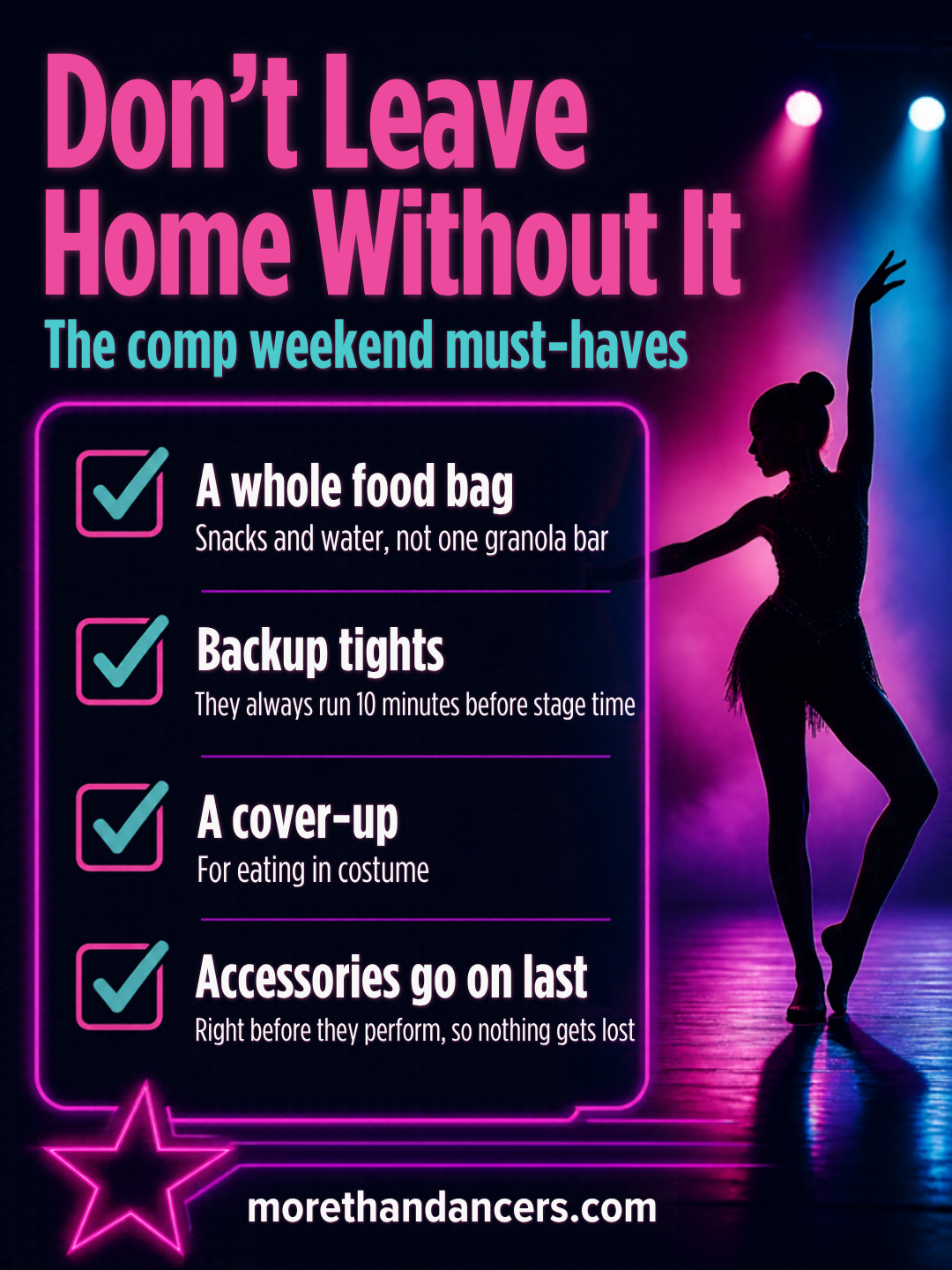
1. Not enough food. Bring a bag that is all about food, snacks and water. Not a granola bar tossed in the costume bag. A whole bag. Long days, late awards and expensive venue food add up fast, and a hungry dancer is a stressed dancer.
2. No cover-up. Dancers are famous for wanting to eat right before they go on stage, already in costume. One drip of ketchup and you've got a big mess. Pack a big T-shirt, robe or zip-up they can throw on over their costume any time they eat.
3. No backup tights. Tights run. Usually ten minutes before stage time. Always pack a spare pair.
4. Lost accessories. Here's my rule: never put an accessory on your dancer until they're very close to performing. Hair pieces, gloves, jewelry and props disappear fast backstage. And when one dancer out of 5, 10 or 15 is missing an accessory, the whole group looks off. That's one of the biggest stressors for coaches and teachers, and it's completely avoidable.
The full packing list
Pack the night before, and check it against your studio's own list since every team does things a little differently.
For the stage
- Every costume, each in its own labeled garment bag, with accessories bagged with it (and kept there until it's almost time)
- All tights, plus a spare pair
- All shoes for every routine, labeled with your dancer's name
- Hair pieces, bobby pins, hair ties, hair nets, gel and hairspray
- Makeup, lashes and lash glue, and makeup remover wipes
- Safety pins and a small sewing kit
- Clear nail polish for tight runs, and fashion tape
For comfort
- A cover-up for over costumes, especially at mealtime
- Comfortable warm-up clothes and slides or sneakers
- A phone charger and a portable battery
- A small towel and a hand mirror
- Any personal care items your dancer usually needs
The food bag
- Refillable water bottles for everyone
- Easy, non-messy snacks your dancer already eats on a normal day, like fruit, crackers and sandwiches
- A small cooler, if the venue allows it
Competition day isn't the day to try a new food. Stick with what your dancer knows works for them.
For you
- Cash for programs, parking and vendors
- Your dancer's routine numbers
- Something to read or do
- A folding chair or seat cushion, if the venue allows them
- A light jacket, since auditoriums can get cold
A rolling garment rack or a dance duffel with a built-in rack makes a huge difference once you have more than one costume. Many families think of it as the best purchase of their first season.
The unwritten rules
These are the things experienced dance parents just know.
Don't enter or leave during a routine. Wait for the applause and walk in between dances. It's a big deal to the dancer on stage.
Cheer for everyone. Clap for every routine, not just your studio's. Dancers notice, and it makes the whole day nicer.
Follow the photo and video rules. Most competitions don't allow parents to film routines because of music licensing and professional photographers. Check before you hit record.
Keep critiques at home. Save any feedback about other dancers, judges or the studio for a private conversation, if ever. Hallways have ears, and other parents are proud of their kids too.
Clean up after yourself. Dressing rooms get messy fast. Grab your bobby pins and wipes before you leave.
What to say on the ride home
This might be the most important part of the whole weekend, and it happens in the car.
Tell your dancer how proud you are of them. Proud of the hard work, proud of showing up, proud of going out there and doing their best. Whether they placed in the overalls or not, whether they got Platinum, Diamond or something else, make sure they hear that it doesn't change how much you love them or how proud you are. A lot of people would be too scared to ever go on stage at all.
Watch your face, too. Sometimes a parent is disappointed in a score, or even frustrated with the studio, and it shows. But your kid doesn't know who that look is for. They receive it as being about them.
And remember that art is subjective. The exact same dance, performed the exact same way, can score higher in front of different judges. Some weekends it just is what it is. What doesn't change is that your voice carries more weight than anyone else's. More than the judges, more than the scores. Use it to tell them you're proud.
The 48-hour rule: wait before you message the studio
This one is big, so I'm giving it its own section. Do not message your dancer's coach, teacher or studio owner about the weekend the night of the competition. Wait at least 48 hours. If the competition was over the weekend, wait until at least Tuesday.
Here's why. Right after a competition, parents can get emotionally flooded. It's so easy to sit down that night and send a long paragraph unloading everything you saw and everything you felt. But think about who's on the other end. Your coaches may have been at that venue from 7 a.m. Friday until 10 p.m. Sunday. They're exhausted, they've given everything they have, and sometimes they're sad or disappointed too, if a routine didn't go the way it should have or a dancer froze on stage.
I like to say a competition weekend is a little like going to battle. You hope everyone comes home with all their limbs and their sanity, because unpredictable things always happen. Everybody is physically and emotionally tired by Sunday night. A message sent in that moment, by text or email, usually just creates hurt that has to be cleaned up later.
So sleep on it. Then sleep on it again. If it still matters on Tuesday, send it then, calmly, or ask for a time to talk. You'll get a much better conversation, and so will your dancer.
Scores and awards can be confusing the first time, so don't worry if your dancer comes home with a High Gold and you have no idea what it means. That's normal, and we've written a whole guide on how dance competition scoring works.
The weekend will be long, loud and full of glitter. Your dancer will also remember it for years. So pack the snacks, bring the spare tights, and enjoy the show.
Want this packing list as a printable? Sign up for the More Than Dancers newsletter and we'll send you the free Competition Weekend Checklist.
Sources: Dance Parent 101, "Dance Competitions Explained"; CLI Studios, parent guide to a convention or competition weekend.
More from
For Parents
category


