




Your dancer just made the competition team. You're proud, they're thrilled, and then the fee sheet comes home. If your first thought was "wait, how much?", you're in good company.
I've helped run a competitive dance studio for more than a decade, and here's what I've learned: competitive dance shouldn't surprise you. The cost is real, but it's very predictable once you know where the money goes. A good studio will walk you through it before you ever say yes. Here's the full picture, plus two sample budgets so you can see how it adds up.
The question every new parent asks
At our studio we hold an info session before auditions, and we show families a range. The low end is the minimum: one dance, no solo. The high end is three or four dances plus a solo. Where your family lands depends on how many dances your dancer is cast in and how many you decide to do.
And the question I get more than any other? "If she does a solo, how much more would that be?"
It's a fair question, because a solo is the most expensive entry at a competition. On top of the entry fee, a solo needs rehearsal time of its own. At our studio, anyone can do a solo, because it's one of the fastest ways a dancer grows. But if you do one, you rehearse it every week in a private lesson, whether that's 30, 45 or 60 minutes. That part isn't optional. Why pay for the most expensive entry at the competition if it's never rehearsed?
So when you're thinking about a solo, think about the entry fees, the choreography, the costume and a weekly private. That's the real number.
Where the money goes
Almost every competitive dance budget comes down to six buckets.
1. Classes and team fees. This is the base. Competitive dancers usually take several technique classes a week on top of team rehearsals. Dance Parent 101 puts technique classes at around $250 a month, with a team fee of $50 to $300 and an audition fee of $20 to $50. Your studio might bundle these together or charge them separately, so ask for the full list.
2. Choreography. Every routine has to be made by someone. For group dances, studios often split the choreographer's time across the dancers, which Dance Parent 101 lists at $15 to $50 an hour per dancer. Solos are the big jump: private choreography usually runs $50 to $100 an hour, often with a minimum of several hours to set the routine. Music editing can add a little more.
3. Costumes. A simple costume can be $50 to $200. Add rhinestones and you're often looking at $75 to $500. A fully custom solo costume can run $250 to $1,000. Then come tights, shoes, hair pieces and accessories, which can add another $50 to $300 across the season, and sometimes props.
4. Competition entry fees. You pay for each routine at each competition. At regional events, Dance Parent 101 lists solos at $150 to $350 and group routines at $75 to $200 per dancer. Nationals cost more: solos at $150 to $500 and groups at $100 to $300 per dancer. Many events also charge a registration fee per competition.
5. Travel. Local competitions might just mean gas and lunch. Out-of-town events mean hotels, at least $125 a night, plus meals, which can easily be $75 to $150 a person per day. Flying to nationals can add $500 to $1,000 per person in airfare. Remember you're usually paying for at least two people, the dancer and you.
6. The extras. Private lessons, competition photos and videos, headshots, team jackets, convention dancewear, merch, snacks, and the thing your dancer forgot at home and you had to buy at the vendor booth. Individually small, together not small at all.
One helpful benchmark from Dance Parent 101: a single competition weekend with travel can run anywhere from $1,500 to $7,500 for one dancer, depending on how many routines they're in and how far you travel.
Why your studio's entry fee might not match the competition's
Here's one that some parents notice but don't always ask about. You look up a competition online and see that the studio is charging a little more per entry than the competition lists. What's that about?
Two things, usually. First, your dancer's teachers are at that competition all weekend, coaching, warming up routines and handling everything backstage. A small upcharge per entry helps cover that time, because the coaching fee alone isn't enough to pay someone for a whole weekend. Second, timing. Many studios send out the season budget in early summer, but competitions often don't release their new pricing until after nationals. A little cushion means families don't get a second bill if fees go up.
If you're ever unsure, just ask. A good studio will happily explain it.
Two sample budgets (a regional season in Texas)
These are based on what a competitive studio in Texas charges for a regional season this year. Both cover five events, three convention and competition weekends plus two competition-only weekends, along with monthly tuition, rehearsals, costumes, choreography camp, team gear and a recital fee. Neither includes nationals. Nationals is its own different beast and deserves its own budget. If you live in another state, especially near a big city, expect these numbers to run higher.
The low end: one group routine, no solo.
- Tuition and rehearsals: about $360 a month, or about $3,800 for the season.
- Competition investment: about $2,200 for entry fees, convention fees, coaching fees, a costume, choreography camp, team gear and the recital fee.
Total: about $6,000 for the season.
The high end: three group routines and one solo.
- Tuition and rehearsals: about $460 a month, or about $4,850 for the season.
- Competition investment: about $4,300 for the same five events with four routines.
- Solo privates: one private a week to rehearse the solo, about $40 for 30 minutes up to about $70 for an hour. Over a season of roughly 40 weeks, that's about $1,600 to $2,800. Private rates vary a lot by studio and area, so ask yours.
Total: about $10,750 to $11,950 for the season, depending on private lesson length.
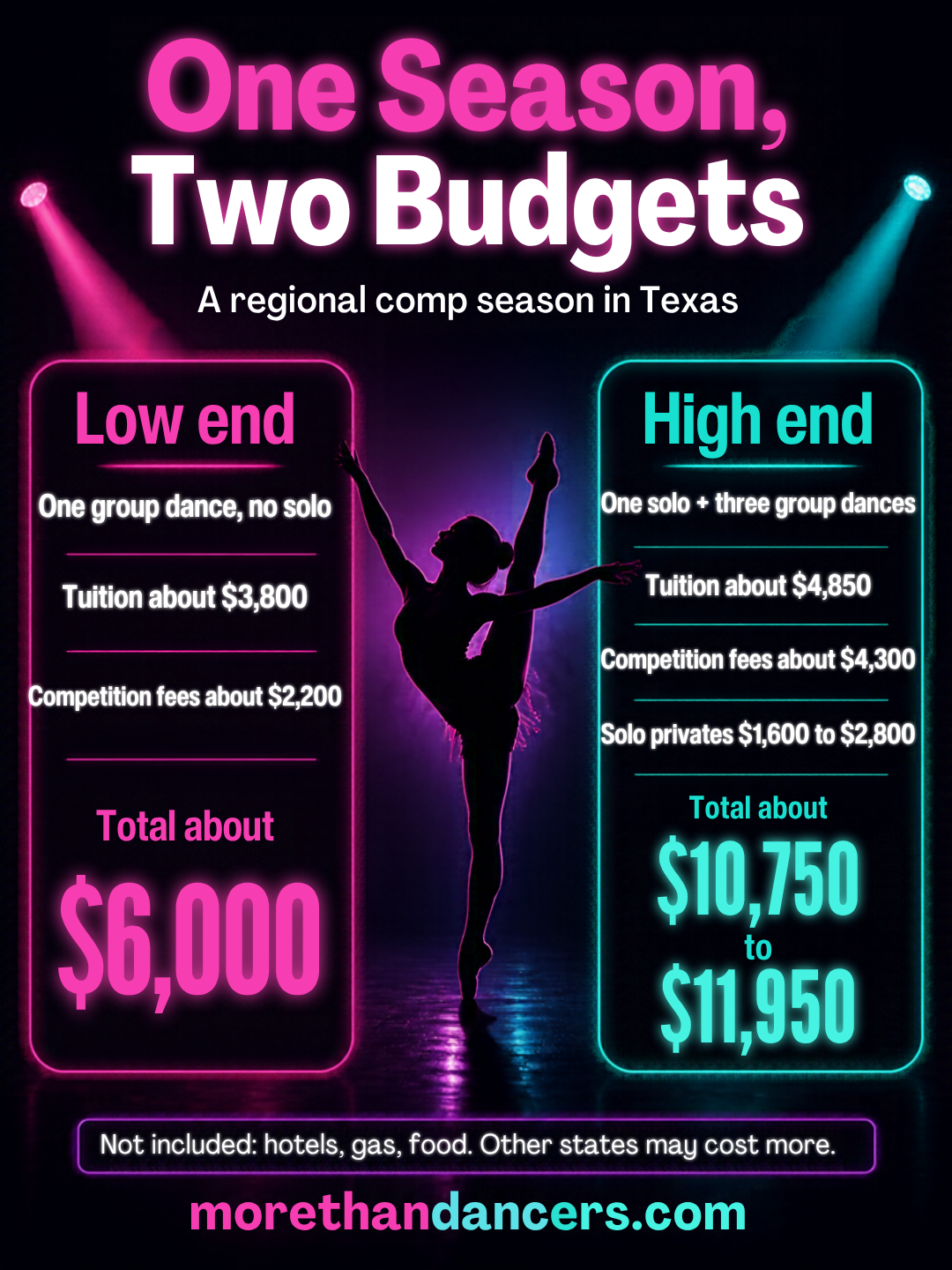
What isn't in these numbers: hotels, gas and food for the convention weekends, and any deposit your studio asks for to hold your spot. Ask your studio about each one so you can add them in.
The gap between the two is mostly the solo and the extra routines. Which is good news, because those are choices you get to make with your eyes open.
What a no-surprises studio looks like
We work hard to make sure nothing about cost catches a family off guard. When you accept a spot on the team, you should know exactly what you're going to pay. Here's what that looks like in practice, and what to ask for if your studio doesn't offer it yet:
- A budget before you commit. You should know how many dances your dancer is in and what the season will cost, with a low and a high end.
- Someone to go through it with you. Ask questions. Your studio should be able to answer every line.
- Payments spread out. At our studio, the full competition cost is split into 10 monthly payments so it doesn't feel as brutal as one big event bill. Tuition comes out on the 1st and company dues on the 15th, so you always know what's coming.
- Extras listed separately. Private lessons and optional competitions come on top. Knowing that up front keeps them from feeling like surprises.
One honest note: the first year comes with so much information and excitement that it's easy to skim past the numbers. Take the budget home, read it twice, and ask about anything that doesn't make sense.
How to keep costs down (what actually works)
These are the habits I've seen make the biggest difference for real families.
Pack food. Seriously. Food at competitions and conventions is expensive, and so are the Ubers to go get it. Pre-make snack boxes before the weekend. For multi-day conventions, hit a grocery store when you arrive so you're not buying every meal at the hotel. This one habit saves families more than almost anything else.
Book the hotel early at the group rate. If you're going to conventions or out-of-town competitions, the group rate is usually the best deal, and it fills up. Book as soon as the dates are out.
Set a private lesson budget and stick to it. Privates are one of the best investments in a dancer's growth, and also the easiest cost to let creep up. Decide how many you're doing this season and hold that line.
Budget for merch. You will spend a little more at competitions and conventions than you planned. There's always a shirt, a jacket or a hoodie with the event logo. Set a merch amount before you walk in, and that vendor booth won't wreck the month.
Decide on solos with your eyes open. A solo can be a wonderful growth experience. Just count the weekly privates, choreography, costume and higher entry fees, not only the entry. It's okay to wait a year.
Pick nationals carefully. Nationals is its own budget, on top of a regional season. Not every team goes every year. Ask whether nationals is expected or optional, and whether the studio picks events you can drive to.
Share where you can. Carpool to competitions, split hotel rooms with another team family, and ask about buying or selling used costumes when routines allow it.
Set aside a little every month. If your studio doesn't already split the season into payments, do it yourself. Take your estimated total, divide by 10, and set that aside each month. Paying about $600 a month is a lot easier than finding $2,000 in February.
Is it worth it?
Only your family can answer that, and the answer can change from year to year. What competitive dance gives kids, like discipline, teamwork, confidence on stage and friendships that last, is real. So is the strain a surprise bill puts on a household. Going in with a clear budget lets you enjoy the season instead of dreading the next envelope.
Want a budget sheet to plan your own season? Sign up for the More Than Dancers newsletter and we'll send you the free Comp Season Budget Sheet.
Source for price ranges: Dance Parent 101, "The Real Costs of Competitive Dance: A Parent's Run Down." Sample budgets are rounded from one Texas studio's current regional season pricing.
More from
For Parents
category


